Having a hard time monetizing your YouTube meditation or relaxation channel?
YouTube Partner Program revenue is only one option. You can also earn through memberships, sponsorships, affiliate offers, digital products, and other revenue streams.
Start here: How To Monetize YouTube Meditation Channels.
But there is another option that has become much more accessible: build your own meditation or relaxation app.
Can You Build A Meditation App Without Knowing How To Code?
Yes. Advances in AI coding and “vibe coding” tools make it possible to create surprisingly capable web and mobile apps by describing what you want in plain language.
You still need to test the finished product carefully, especially user accounts, privacy, payments (if applicable) and audio delivery. But you no longer need to be an experienced programmer just to build and test a meditation app idea.
Can You Use TunePocket Music In A Meditation App?
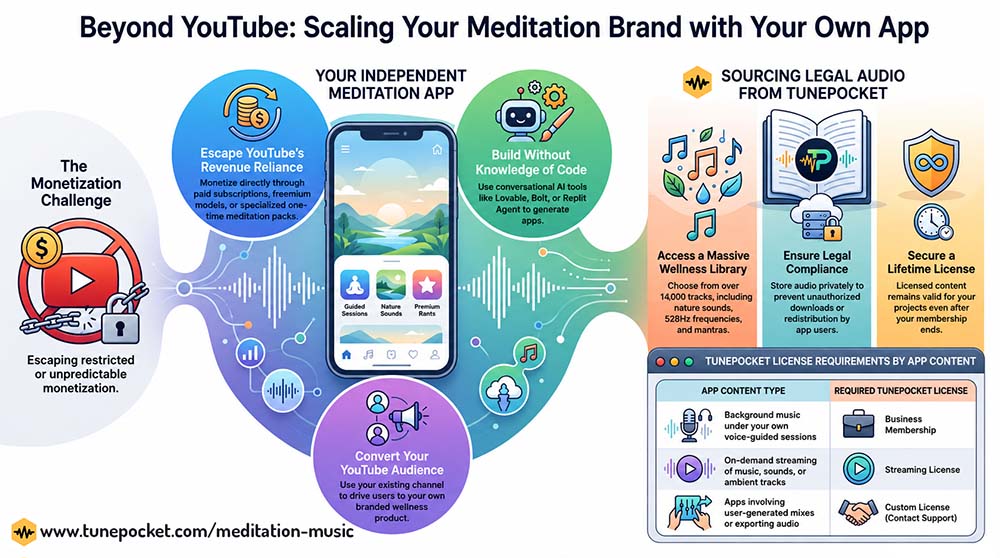
Yes! TunePocket licensing supports music in apps and software, but the correct licensing setup depends on how app users interact with the music.
There are two common scenarios:
1. Guided Meditation Apps
If you create your own guided meditations, sleep stories, breathing exercises, or spoken relaxation sessions and use TunePocket music as background audio, this is treated differently from creating a music or sounds streaming app.
For this type of app, TunePocket recommends a Business Membership. The music becomes part of your finished meditation or spoken-content experience rather than being offered as a standalone music library.
2. Music And Soundscape Streaming Apps
If users can browse, select, and stream TunePocket music, ambient tracks, or sounds directly inside the app, you need TunePocket’s Streaming License.
This applies, for example, to an app where a user selects “Deep Sleep,” “Rain Ambience,” or a particular relaxation track and listens to that TunePocket recording directly.
See the detailed explanation here:
How To Properly License Music For Your Meditation, Relaxation Or Sleep App.

AI Coding Tools For Building A Meditation App
Here are several popular AI app builders worth exploring:
Lovable lets you describe an app in natural language and generates the interface, application logic, and supporting code. It is particularly approachable for non-technical creators.
Replit Agent can build, test, fix, and deploy applications from conversational instructions, making it useful for taking an idea from prototype to a working online app.
Bolt creates websites and full-stack applications from prompts directly in the browser and can be used to quickly prototype an audio or wellness app.
For example, you could ask an AI coding tool to create a simple relaxation app with categories for sleep, focus, meditation, and calming soundscapes, along with an audio player, favorites, timers, and user accounts.
How To Monetize A Meditation App
A meditation app can generate revenue directly from users instead of relying on YouTube advertising.
-
Offer a paid subscription.
Give subscribers access to your full library of meditations, sleep sessions, relaxation music, or premium features for a monthly or annual fee.
-
Use a freemium model.
Offer a useful selection for free, then charge for additional sessions, categories, longer programs, offline features, or other premium content.
-
Sell lifetime access.
A one-time purchase can appeal to users who prefer not to add another subscription.
-
Sell specialized programs.
Create paid meditation packs or programs focused on specific needs such as sleep, stress reduction, focus, breathing, or relaxation.
You can also combine these models. For example, offer a free basic app, a premium subscription for the full content library, and separate paid programs for specific goals.
How To Keep Your Meditation App Compliant with TunePocket license
The key principle is simple: your app can provide a licensed listening experience, but it should not become a way for users to obtain or redistribute TunePocket audio files.
You need to follow these simple rules:
-
Do not offer the original music files for download.
Users should listen to the music through your app rather than downloading TunePocket tracks to their devices.
-
Do not expose the source audio files.
Store and deliver the audio so users cannot directly access, copy, share, or extract the licensed recordings.
-
Use the appropriate license for direct streaming.
If users can independently choose and stream TunePocket music or soundscapes, use the Streaming License rather than treating the audio simply as background music.
-
Do not turn the app into a music download library.
The license does not allow you to create a catalog where users browse TunePocket tracks and save the original recordings for their own use.
-
Do not redistribute or sublicense the music.
You are licensing the recordings for use within your application. You are not purchasing the copyright or the right to redistribute TunePocket music independently.
For the complete legal terms and restrictions, see the TunePocket Licensing Agreement.
Turn Your YouTube Audience Into Your Own Product
If your meditation channel already attracts viewers but YouTube monetization is difficult or unpredictable, an app gives you another way to build revenue around the same audience and content niche.
You can continue growing your YouTube channel while using AI coding tools to experiment with your own sleep, meditation, relaxation, or focus app.
And if your app needs meditation music, ambient backgrounds, or relaxation sounds, TunePocket can help you license the audio for the appropriate type of app.
Frequently Asked Questions
Can I Edit Or Loop TunePocket Music In My App?
Yes. You can trim tracks, add fades or crossfades, make normal technical adjustments such as volume normalization or EQ, and create seamless loops to fit longer meditation, sleep, or relaxation sessions.
These edits should be made as part of your licensed app use. The edited or looped music cannot be redistributed, sold, exported, or offered to users as a separate audio file.
Can Users Mix The Music With Other Sounds?
Yes. With the appropriate Streaming License, your app can combine TunePocket music with other audio elements such as white noise, nature sounds, binaural beats, or separately licensed sound effects.
The important limitation is that users should be listening to the resulting soundscape inside your app. The app should not allow users to export, download, share, or otherwise obtain TunePocket music or a derivative audio file.
How Should Music Be Delivered Inside The App?
TunePocket music should be stored privately and delivered in a way that prevents users from accessing or downloading the underlying audio files.
For example, you can use protected cloud storage, temporary signed CDN links, and private in-app caching for playback. Temporary caching is acceptable when the files remain inside the application’s private storage and cannot be exported, shared, or accessed directly by the user.
The goal is simple: users can listen to the licensed music through your app, but they should not receive the actual music files.
Free infographic
Download 14,000+ Royalty Free Music Tracks And Sound FX
Unlimited download | Lifetime license | Commercial use